

10 tips for improved communication during conflict and negotiations.
- The only thing you can change in a negotiation or conflict is what you do!
- The way you communicate will either hinder, or help you.
- Like much in life, conflict is inevitable, however, it can be useful but it depends whether you see it as an opportunity.
- Before you can discover possible strategies to resolve conflict, you must first understand its complexity and what the conflict has to tell you.
- You MUST listen to the other side’s story, it’s hard to listen in conflict however, you must to understand.
- Listen to what is behind the words – don’t just hear attack – hear why.
- Ask questions with the intention to understand.
- Speak yourself without attack – think ideas and principles – not positions.
- Promote useful dialogue between you and the other side.
- Conflict and negotiation does not get fixed from the outside, they may be helped by someone like me, but ultimately it’s about the people involved and their understanding and positive engagement.
My articles are published on LinkedIn's Pulse, click to view
Emotion during mediation – good or bad?
As mediators we control the process of mediation. Personally, I believe we should be leaders too, and to that extent we should lead the parties’, ensuring that they are focused on productive negotiation, their future and not the past. Mediators are generally taught to chair joint sessions and to some degree control the parties’ emotions. The reason, as I see it, is because people are uncomfortable in conflict but as mediators we need to be comfortable in conflict. I can understand lawyers who tell me that they are concerned that the joint session may become confrontational, causing further entrenchment and polarising positions even further. I too want to ensure the process is designed to give the parties’ the best chance to settle. However, mediation is negotiation, and without negotiation, there is no mediation. Negotiation is a social exchange, the parties’ pit against each other’s opposing motives. In my experience, more and more commercial mediations are taking place without a joint session. However, it may be that parties’ who miss this part of the process might be missing a trick - the emotions of the other party!
Emotion has always been seen as something that impedes performance. Emotion has until recently been seen to prevent coordination and cooperation. However, recent research has shown that the expression of emotion within a negotiation can both help and hinder the process. Interestingly, it has been shown that an expression of anger (so long as it is genuine) elicits larger concessions from the opposing party. This may seem obvious to some hard-ball negotiators, but others may believe that anger must push parties’ further apart. However, it must be noted that it is most effective when the party who is seen to be more powerful shows anger, when a weaker party expresses the emotion it has less affect. Ury and Fisher’s eminent ‘Getting to Yes’ urged parties’ to focus on the problem and not the person. Ury and Fisher were implying that emotions expressed in task related exercises were more effective than expressing emotions directed at the opposing party or person. Recent research posits expressing anger only benefits when the conflict concerns interests and not when it concerns disputes over values. Expressions of anger over value trigger retaliation and escalation of conflict. So, when can an expression of anger achieve favourable outcomes? A number of factors must be present:
- Anger is directed at the task rather than the other party or person;
- The anger is viewed as justified;
- The relationship is interdependent;
- The expression has informational value;
- The parties’ take a strategic approach that encourages the use of expression as information that can aid coordination, and;
- The target of anger has few opportunities to deceive.
Much has been written on the effects of negative emotion, but what of positive emotions? Research shows that positive emotions facilitate deal making together with the increased likelihood of future relationships. Research shows that people negotiating with positive emotions look to the future, which increases cooperation and creativity. As party representatives, you may be able to improve the parties’ emotions through positive framing, education of negotiation and mediation processes.
Therefore, whether you are a mediator, a lawyer, or a party in a mediation, be aware of these factors. Much can be gleaned from parties’ during mediations. So do not be too quick to write-off the joint-session as a bad idea!
Depending on which side of the table you are on and what your position is, you may be able to utilise these factors to shape yourself a better deal.
My articles are published on LinkedIn's Pulse, click to view.
12 things to help you be a better negotiator.
- Fearlessness is stupidity and courage is just a way of not letting fear defeat you.
- It takes courage to enter the arena of conflict. Courage is something that is chosen, no-one was born courageous; it is in how we react to difficult situations – how you control your feelings and emotions during negotiations is under your control. Only fools do not get scared – everyone has weakness, but it is important to learn to deal with it positively.
- Sometimes you must put on a front – sometimes that front, is courage. People are often disarmed by friendliness and informal manner (think of Nelson Mandela). This can work well in a negotiation, ask yourself, what are the other side expecting of you- maybe the opposite of what they expect will help you?
- Control is the measure of a leader – indeed all human beings – calm is what people look for in tense and difficult situations. They want to see composure and that you are weighing up all the factors, with a measured response – I call it, a non-anxious presence.
- Do not rush. Wait before making decisions during negotiations – consider all of the options. You cannot always have all the information before making a decision, but there is great value in forming a complete picture before taking action.
- Don’t hurry; think, analyse, then act.
- Leaders must not only lead but they must be seen to be leading – negotiation is about getting things done!
- Strategy and tactics – concentrate on only principles and ideas.
- When conditions change, you must change your strategy and your mind. That’s not indecisiveness, that’s pragmatism.
- Conflict (and life in general) is never as simple as yes or no. The reasons behind conflict are rarely clear – there are never simple answers to difficult questions, all explanations maybe true. Every problem has many causes, not just one.
- If you are a facilitator involved in negotiation you must inspire a sense of trust, as trust is the foundation of leadership. Everyone trusts that a leader is honest, able, and has a vision of where to go.
- To those who say “everything happens for a reason”, Nelson Mandela would reply, “we are the reason and we are the ones who make things happen, there is no destiny that shapes our end; we shape it ourselves.”
My articles are published on LinkedIn's Pulse, click to view.
Another very good reason to mediate!
Up to 600% rise in court fees to increase use of mediation.
On 9 March 2015, the Ministry of Justice brought into effect increased court fees by up to 600%.
This will undoubtedly restrict the parameter of claimants who have the financial ability to issue a claim.
It is inevitable that parties will have little option but to attempt to resolve claims pre-issue. The courts have been encouraging parties' to use alternative dispute resolution processes for some time, and these fee increases further the push for the use of mediation.
| Increases in Civil Court Fees as of 9th March 2015 | |||
| Value of claim (£) | Fee pre-9th March 2015 (£) paper | New fee as of 9th March 2015 | % increase |
| 20,000 | 610 | 1,000 | 64% |
| 40,000 | 610 | 2,000 | 228% |
| 90,000 | 910 | 4,500 | 395% |
| 150,000 | 1,315 | 7,500 | 470% |
| 190,000 | 1,315 | 9,500 | 622% |
| 200,000 | 1,515 | 10,000 | 576% |
| 250,000 | 1,720 | 10,000 | 481% |
Articles and blog
Click the image to read a high resolution copy of the article
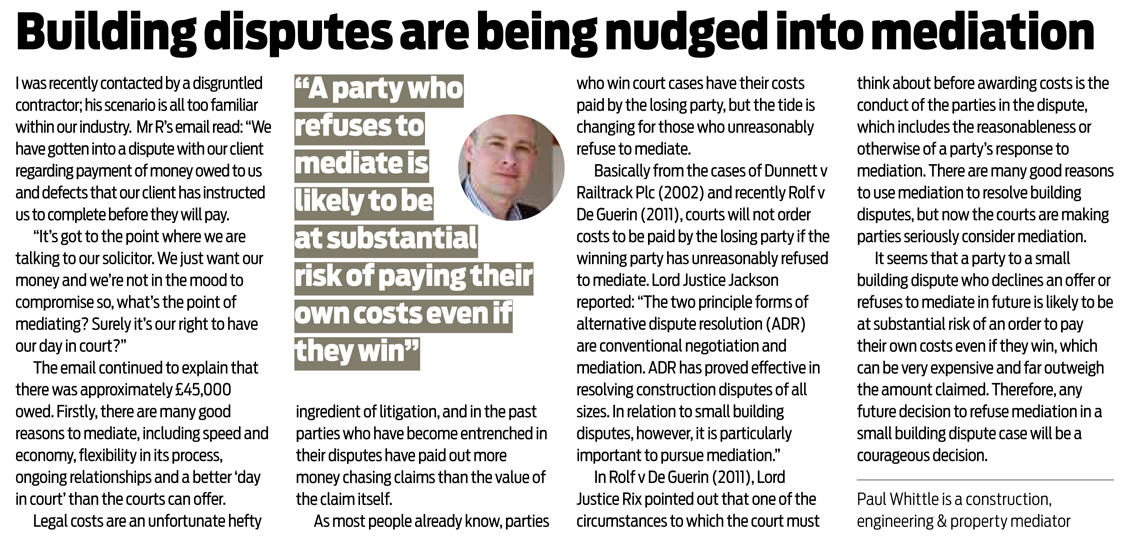
Image used courtesy of Construction News Magazine
Previous articles-
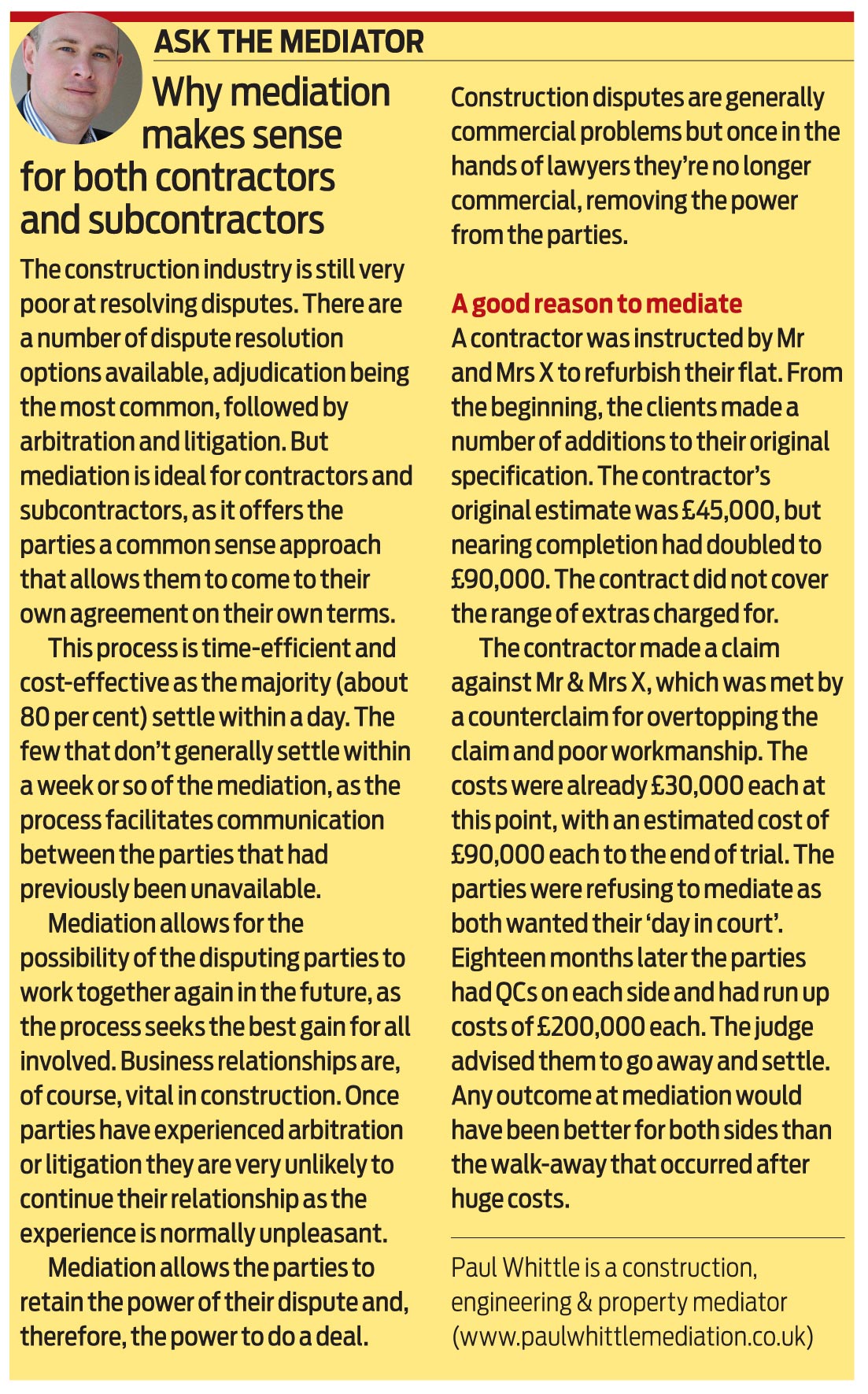
September Issue- 'Why mediation makes sense for both contractors and subcontractors'